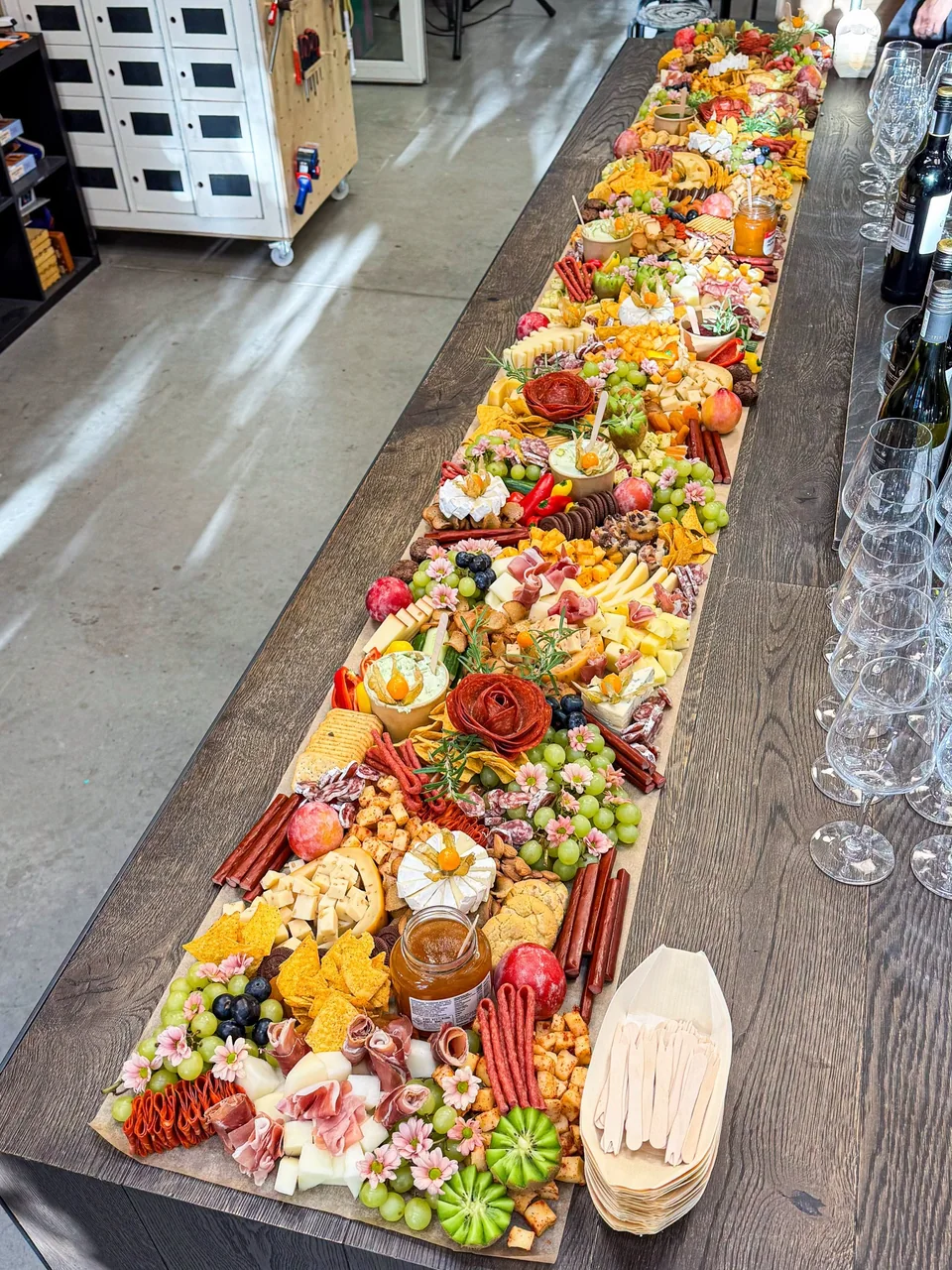
Start a corporate grazing-table budget with the event’s job: employee reception, client hospitality, open house, meeting break, recruiting event, or conference networking. Add the number and arrival pattern of guests, service window, other food, exact address and room, building access, guest-ready time, dietary communication, and internal approver. A custom proposal can then price one defined outcome instead of a vague “table for the office.”
Tie the budget to what guests will be doing
A standing client reception needs food that supports conversation and movement. A meeting break has a short service window. An open house may receive guests in waves. An employee-appreciation event may combine speeches, activities, and other catering. These formats should not share one quantity or setup assumption simply because the headcount matches.
Write the agenda times next to the food plan: doors open, presentation begins, table opens, other food appears, and event ends. That reveals whether the grazing table is a welcome, an accompaniment, or the primary food experience.
Corporate proposal inputs that affect scope
| Input | What the requester should provide | Why it matters |
|---|---|---|
| Event purpose | Employee, client, recruiting, launch, holiday, meeting, or conference | Sets the expected tone and food role. |
| Attendance | Current estimate, final-count date, and arrival pattern | Changes scale and pressure on the serving area. |
| Agenda | Guest arrival, remarks, break, food, and end times | Defines the guest-ready deadline and service window. |
| Food program | Other appetizers, meals, desserts, beverages, and vendors | Prevents duplication and unclear meal expectations. |
| Building access | Parking, loading, security, elevators, suite, room, and contact | Determines how the setup reaches the event. |
| Surface and room | Table dimensions, placement, registration, bar, and traffic routes | Protects guest flow and usable installation space. |
| Dietary communication | Collection method, deadline, labels, and contact | Allows requests and limitations to be discussed early. |
| Commercial process | Approver, proposal deadline, required documents, and payment process | Keeps the request from stalling after the food plan is ready. |
Budget for the real address, not the map pin
For a Minneapolis or St. Paul office, the street address may be only the beginning. Identify the loading or parking entrance, security desk, elevator, floor, suite, event room, and name and mobile number of the on-site contact. Hotels and conference venues may route vendors through a separate service area.
Ask whether the building requires advance vendor registration, a certificate of insurance, a reserved loading window, or an escort. Confirm current requirements directly with the property. A precise access plan protects both setup time and the internal host’s attention.
Use the venue-access checklist and, for downtown properties, the Minneapolis outside-catering questions.
Three corporate briefs with different budget logic
Employee appreciation reception
State whether people arrive at once or drop in by team, whether remarks or activities interrupt service, what other food exists, and who communicates dietary information. Protect the table from normal workplace traffic and assign a room owner.
Client open house
Estimate the arrival window rather than only the invitation count. Explain whether guests tour the space, where registration happens, whether the bar shares the room, and how the table supports the brand environment without blocking circulation.
Leadership meeting or conference break
Give the exact break time, room availability, attendee count, cleanup deadline, and whether food remains after the session resumes. A short fixed window needs a different access and handoff plan than an open reception.
Do not ask a provider to solve an undefined meal expectation. Tell them whether attendees should consider this a snack, appetizer, substantial reception offering, or part of a larger catered program.
For event-specific operating plans, use the dedicated corporate open-house guide and board and leadership meeting guide.
Make the proposal easier to approve internally
Give the provider one requester and one final approver. Request a proposal that states the event assumptions, included service, exclusions, guest-ready result, payment schedule, and details that may still change. Attach the agenda and access notes so procurement or leadership sees the business need behind the total.
When comparing options, use the scope checklist. Preparation, delivery, and complete on-site styling should not be compared as if they were identical to a food-only drop-off.