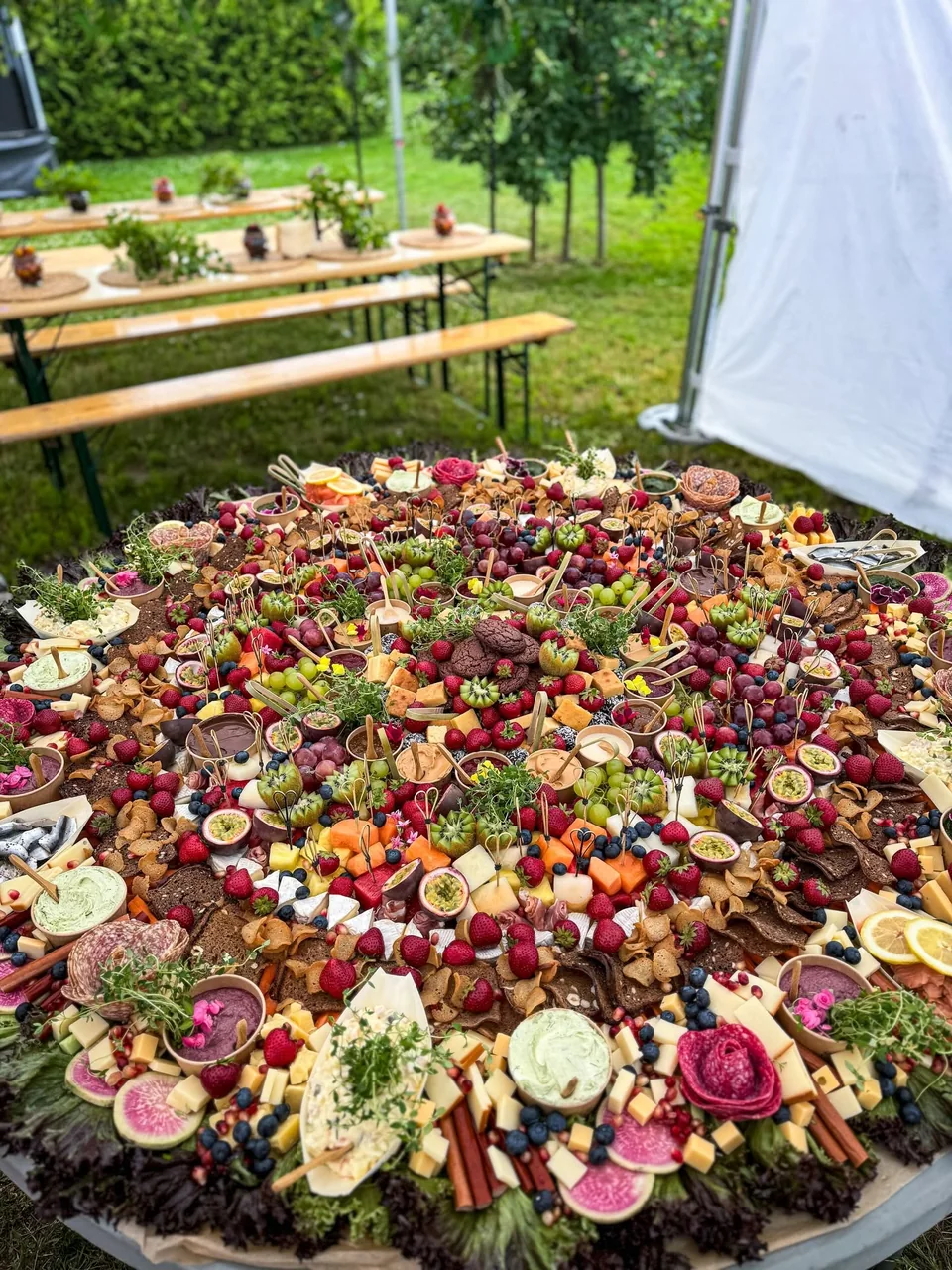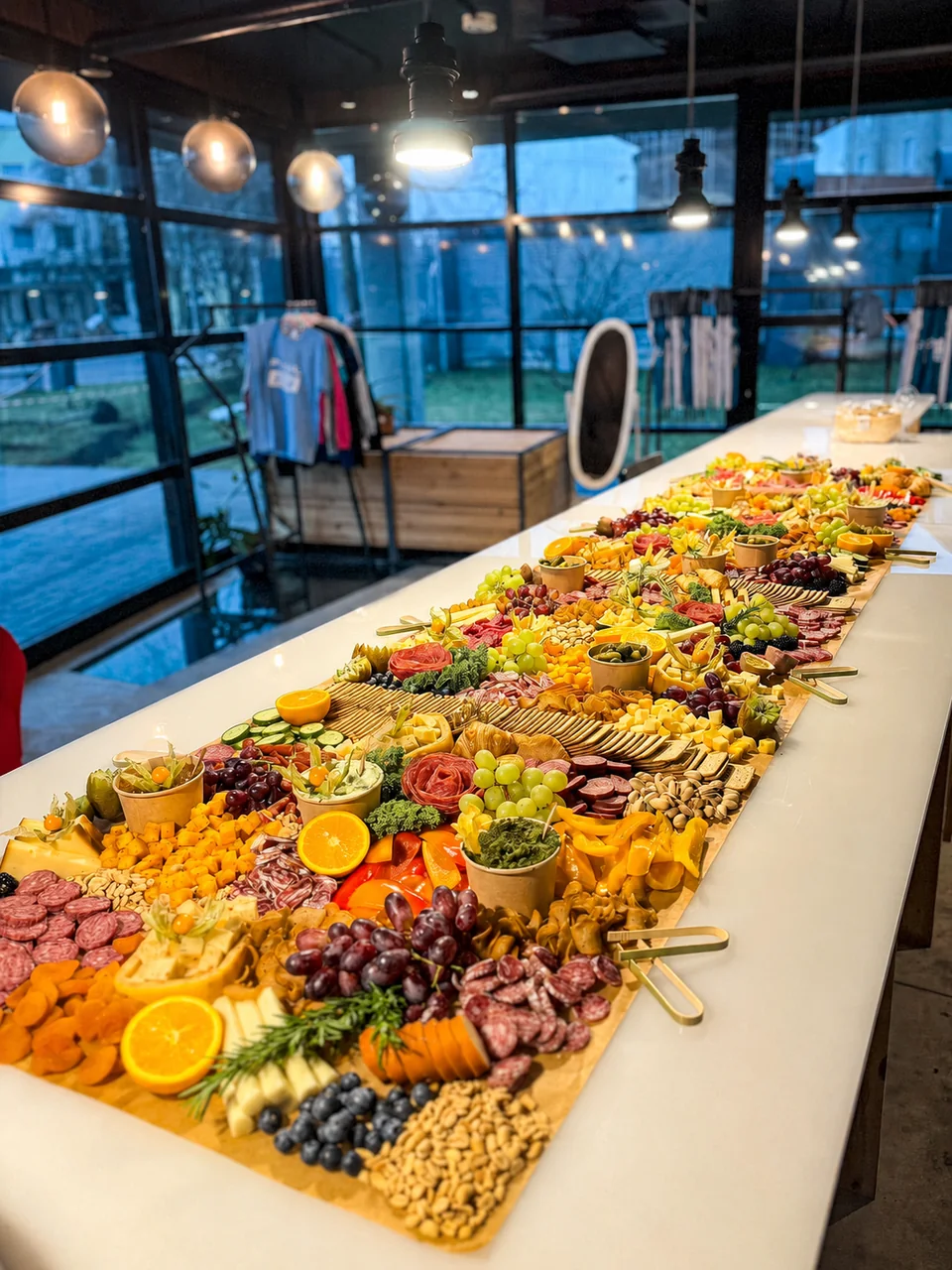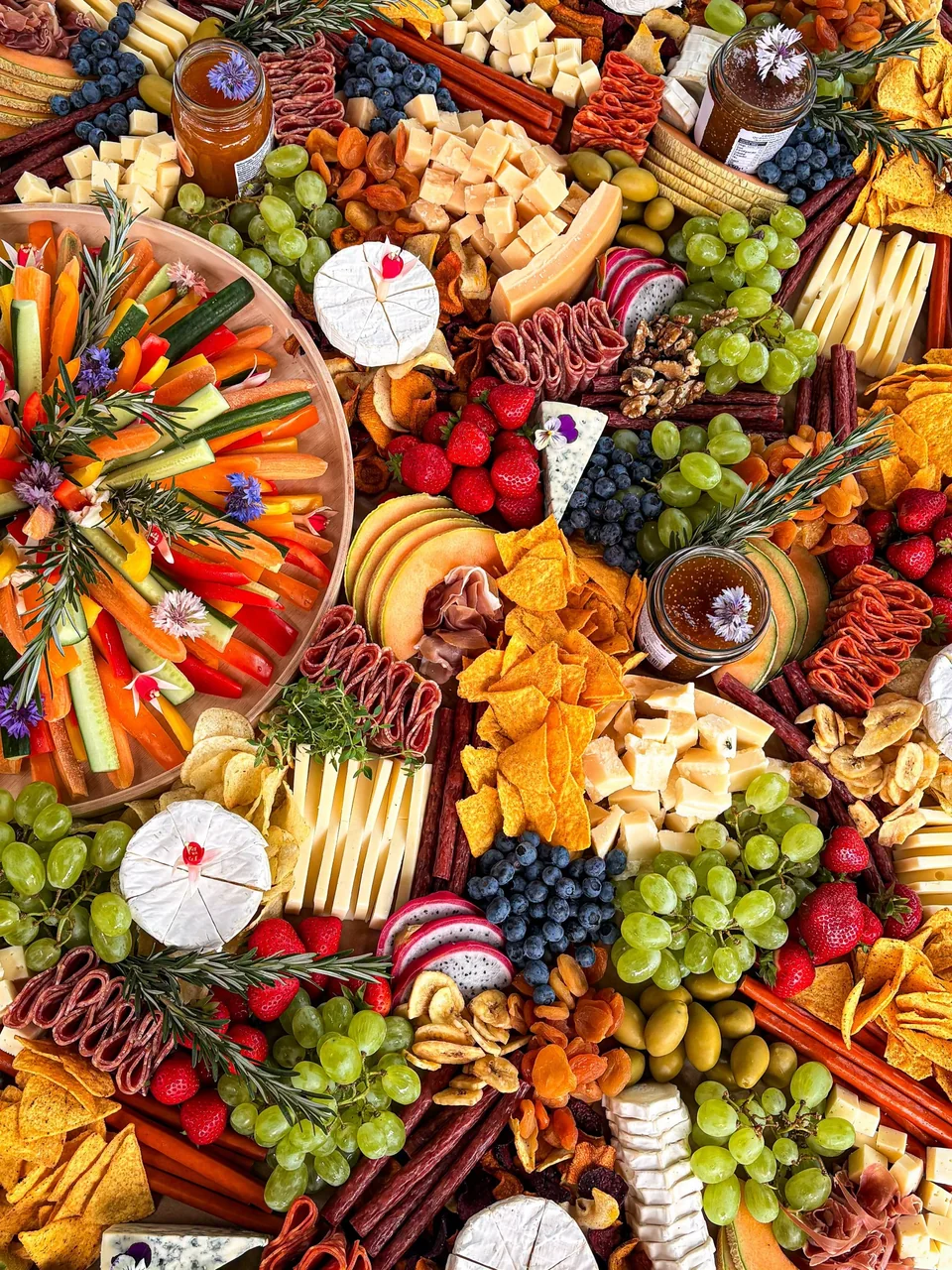
The most useful answer begins with a better question: what job does the grazing table need to do? A table offered before dinner has a different purpose from one serving as the main food experience at a reception. Two events with the same headcount can therefore require very different planning.
Begin with the table’s role
Before discussing size, decide how guests will use the table. Is it a light welcome while people arrive? A focal point during cocktail hour? Part of a larger food program? Or the primary grazing experience for the gathering?
The answer affects both quantity and composition. When dinner follows soon afterward, the goal may be to offer variety without leaving guests too full. When the table carries more of the event, it needs to sustain attention for longer and serve a broader range of appetites.
| Role | Planning question | What changes |
|---|---|---|
| Welcome display | How long will arrivals be staggered? | Access, replenishment expectations, and lighter appetites matter. |
| Cocktail hour | How long until the next food service? | The table needs to bridge a defined period without disrupting dinner. |
| Part of a larger spread | What else is being served at the same time? | Overlap should be identified so the table complements, rather than duplicates, the menu. |
| Primary grazing experience | Will guests treat this as the main food? | Appetite, duration, variety, and dietary needs carry more weight. |
Refine the guest count
An estimated headcount is necessary, but not every person uses the table in the same way. Children, adults, vendors, speakers, and people arriving late may all be included differently in the total. Ask who will actually be present while the table is open and whether everyone is expected to eat.
Also consider the shape of attendance. A steady flow of 100 people over several hours is not the same as 100 people approaching at once. The second situation places more pressure on table access and can make an otherwise generous presentation feel crowded.
Questions that make the estimate more useful
- What is the current confirmed count, and how much could it still change?
- Will all guests arrive at roughly the same time?
- Are children included in the count?
- Will staff, vendors, or speakers also eat?
- Is the table available to everyone or only one part of the event?
A single universal “amount per person” can create false confidence. The right recommendation should be based on the complete event, not headcount alone.
Account for timing, appetite, and other food
Time of day changes how guests approach food. A late-afternoon table before dinner is usually experienced differently from a table opened at lunchtime or during an evening event without another meal. The gap between the table opening and the next food service matters too.
List everything else guests can reasonably expect to eat: passed appetizers, plated dinner, desserts, a late-night snack, or food from another vendor. This helps avoid treating the grazing table as an isolated element when guests experience the event as one continuous sequence.
Appetite is also shaped by the event itself. At a standing reception, guests may graze gradually while talking. At a scheduled company meeting, people may have a short, concentrated break. The service window and pace should be part of the brief.
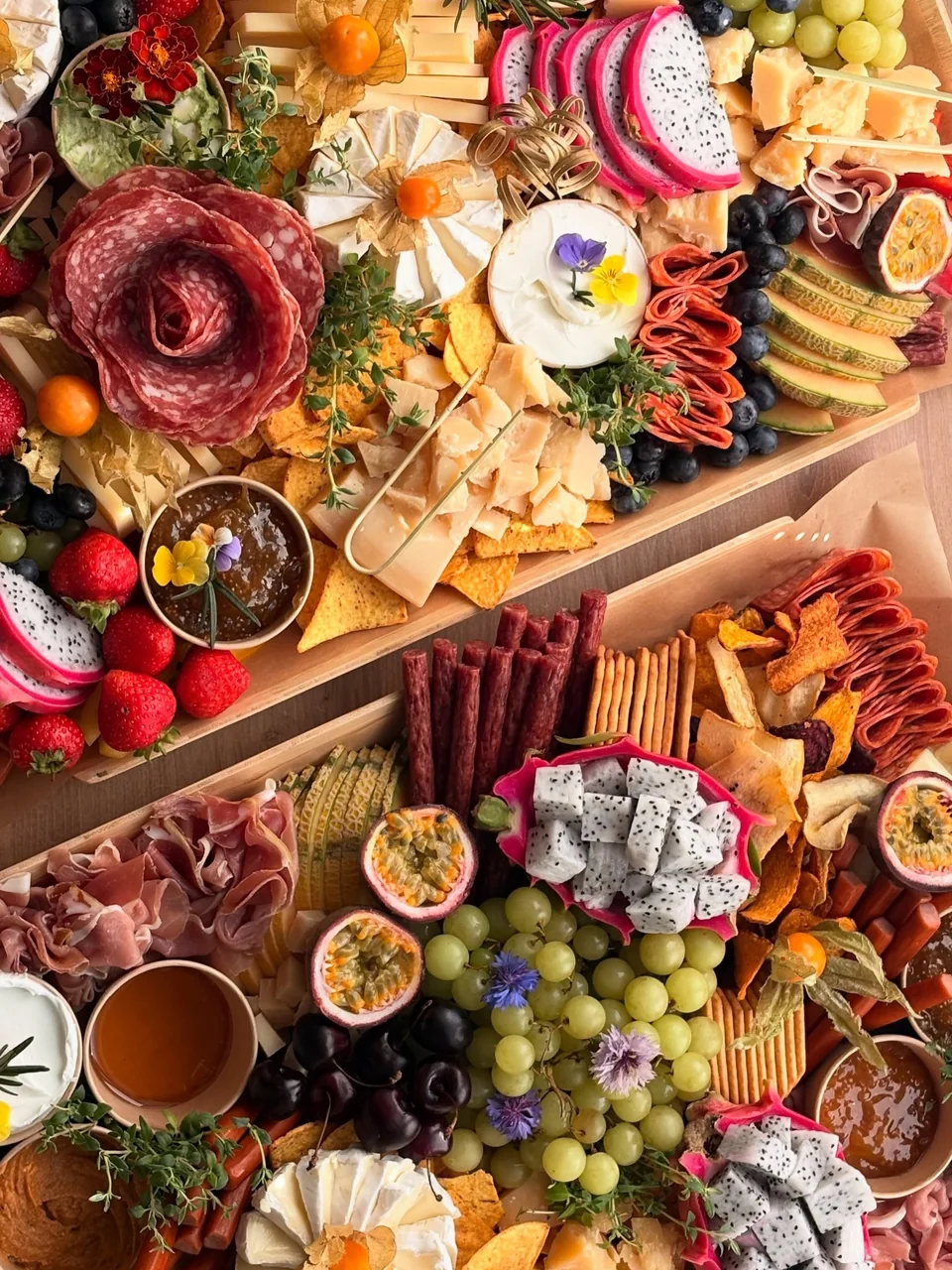
Plan for the room, not just the food
A grazing table must be easy to approach. If it is pressed into a corner, placed in a narrow passage, or positioned beside the only entrance, guests may cluster in ways that make the event feel congested. A larger table does not automatically solve a circulation problem.
Confirm the intended location, available surface, nearby walls, power or access restrictions, load-in route, and guest-ready time. For venues, determine whether outside food vendors are permitted and whether there are requirements for arrival, setup, or cleanup.
If a large group will approach together, think about access from more than one side. If arrivals are staggered, visibility from the entrance may matter more. The physical plan should reflect how the room will actually be used.
What changes at 25, 50, 75, 100, 150, and 200+ guests
Common headcounts are useful planning checkpoints, but they are not portion formulas. Use the ranges below to identify the operational question that becomes more important as attendance grows.
| Guest-count range | Planning focus | Information the provider still needs |
|---|---|---|
| About 25 guests | Decide whether a contained board or a styled table better fits the room and occasion. | Food role, arrival time, other food, and available surface. |
| About 50 guests | Confirm whether guests approach together and whether the display is a welcome, appetizer, or primary grazing experience. | Service duration, room placement, dietary requests, and table dimensions. |
| About 75 guests | Protect circulation and avoid one narrow serving point when the group arrives at once. | Floor plan, bar or registration location, guest-ready time, and other vendors. |
| About 100 guests | Plan the arrival wave, usable surface, approach direction, and how the table fits the full menu. | Final-count process, setup window, venue access, and handoff owner. |
| About 150 guests | Treat guest flow and venue operations as core scope, not last-minute details. | Load-in route, access from multiple sides if available, schedule, and service expectations. |
| 200+ guests | Coordinate the grazing table as one part of a larger event-production plan. | Planner and venue contacts, floor plan, arrival pattern, staffing or monitoring, and other catering. |
These ranges do not tell you how many ounces or how many feet of table to buy. They tell you which questions become expensive to ignore. The actual recommendation still depends on appetite, menu, timing, venue, and service model.
Why a universal per-person formula is incomplete
A per-person number can look precise while hiding the most important assumptions. Fifty guests eating for twenty minutes before dinner do not use a table like fifty guests attending a two-hour open house with no other food. Children, vendors, staggered attendance, menu breadth, and dietary needs also change the plan.
Use per-person language only when the provider explains the food role and service assumptions behind it. For budget planning, compare the complete scope with the grazing-table quote checklist.
Connect quantity to space, safety, and service
More food is not a substitute for a workable room. Confirm the space the table needs, the exact guest-ready time, who provides plates and serving tools, and how dietary requests will be communicated. For longer or outdoor events, plan service timing with the venue and provider instead of assuming the display can remain unchanged indefinitely.
Send a complete event brief
You do not need every detail finalized before inquiring. You do need to separate what is confirmed from what is still flexible. A useful first brief includes:
- The event date and Minnesota location
- The event type and purpose
- The best current guest-count estimate
- When the table should be guest-ready
- How long it will be available
- What other food will be served and when
- Known dietary needs
- Venue access or outside-vendor requirements
With that context, the recommendation can focus on the actual gathering rather than forcing it into a generic quantity formula.
The short answer
Start with headcount, then adjust for the table’s role, time of day, duration, other food, guest arrival pattern, dietary needs, and room layout. That is the difference between merely ordering for a number and planning a grazing table that works naturally within the event.